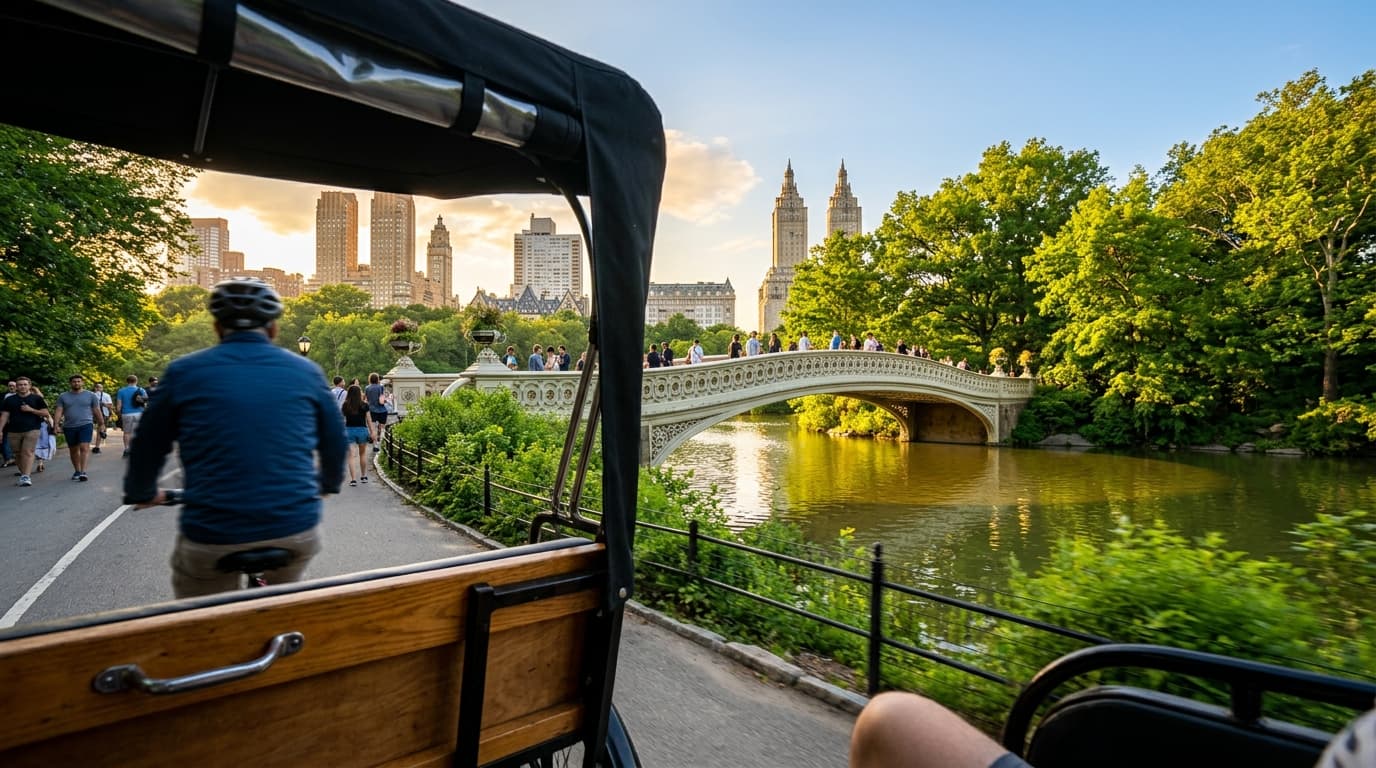
The best photo spots in Central Park are Bow Bridge, Bethesda Fountain, Gapstow Bridge, the Literary Walk, and Belvedere Castle. A pedicab tour is the fastest way to reach all of them in a single session — your driver stops at each location, knows the best angles, and takes the photos on your phone so both of you are in every shot. The Classic Tour ($45) covers all five of these landmarks in one hour. The Grand Tour ($90) adds deeper spots like the Conservatory Garden and the North Woods.
Here is the complete guide to every major photo spot, the best time of day to shoot each one, and how a pedicab makes the difference between getting five great photos and getting twenty.
Why a Pedicab Changes Your Photo Game
Walking between photo spots in Central Park sounds simple until you do the math. Bow Bridge to Belvedere Castle is a 15-minute walk. Belvedere Castle to the Conservatory Garden is another 20 minutes. By the time you reach your fourth stop, you have been walking for an hour and the light has shifted entirely.
A pedicab solves three problems at once:
- Speed between stops. Your driver covers in 3 minutes what takes 15 on foot, which means you spend your time shooting instead of walking.
- Built-in photographer. Every Grinlo driver takes photos at each stop. You hand them your phone, they know the angles, and both of you are in every frame.
- Timed to the light. If you book a Sunset Special ($75), your driver schedules departures so you arrive at the west-facing spots during golden hour — no guesswork.
The result: more stops, better light, and actual photos of you together instead of awkward selfies with half a landmark in the background. Want to see which tour reaches the spots you care about? Explore all NYC pedicab tour options — every route, duration, and price on a single page.
The 10 Best Photo Spots (In Pedicab Route Order)
Your driver will customize the route, but here are the landmark stops in the order most pedicab tours cover them, starting from the meeting point at Central Park South (59th St & 6th Ave).
1. Gapstow Bridge
Where: Southeast corner, near the Pond Best time: Morning (8-10 AM) for skyline reflection Why it works: Gapstow Bridge with the Plaza Hotel and Midtown skyline rising behind it is one of the most recognizable shots in New York. The stone arch frames the water perfectly.
Photo tip: Stand on the south side of the bridge and shoot north for the classic postcard angle. In the morning, the Pond is still and you get a mirror reflection of the skyline. By afternoon, the foot traffic disturbs the water surface.
2. The Literary Walk
Where: Southern section of The Mall Best time: Late morning or afternoon for dappled light Why it works: The double row of American elms creates a cathedral-like canopy overhead. The bronze statues of Shakespeare, Robert Burns, and Sir Walter Scott add foreground interest that makes the photo feel like it could be from any century.
Photo tip: Shoot from the center of the path looking north to capture the full tunnel of trees. In fall, the golden elm leaves create the most dramatic version of this shot. For portraits, stand next to the Shakespeare statue and shoot with a shallow depth of field to blur the canopy behind you.
3. Bethesda Fountain and Terrace
Where: Mid-park at 72nd Street Best time: Golden hour (45 minutes before sunset) for warm side-lighting Why it works: The Angel of the Waters statue is Central Park's most famous sculpture. The two-level terrace provides multiple angles — shoot from above looking down at the fountain, or from below looking up through the ornate arcade ceiling.
Photo tip: The arcade ceiling tiles are hand-painted Minton tiles from the 1860s. Lie on your back on the lower terrace and shoot straight up for a ceiling shot that most tourists miss entirely. For the classic fountain photo, shoot from the northwest corner where the angel is silhouetted against the sky.
4. Bow Bridge
Where: Crossing The Lake between Cherry Hill and the Ramble Best time: Sunset (golden hour) for warm light on the cast iron Why it works: Bow Bridge is the most photographed bridge in Central Park and arguably in all of New York City. The cast-iron railing catches golden light beautifully, and The Lake provides reflections on calm days.
Photo tip: Walk to the center of the bridge and face east for the best background (the Ramble's tree canopy). For couple photos, stand at the railing and have your driver shoot from the western approach — this captures the full curve of the bridge with both of you in frame. The reflection shot works best on windless mornings when the lake is glass.
5. Cherry Hill
Where: West side of The Lake, south of Bow Bridge Best time: April (cherry blossoms) or sunset year-round Why it works: The wrought-iron fountain and circular plaza offer a quieter, more intimate setting than Bethesda. During cherry blossom season (mid-April), the trees frame everything in pink and white.
Photo tip: Use the fountain as a foreground element with Bow Bridge visible in the background. This layered composition — fountain, lake, bridge — is one of the deepest perspectives you can get in the southern park.
6. Strawberry Fields (Imagine Mosaic)
Where: West side at 72nd Street Best time: Early morning to avoid crowds Why it works: The black-and-white "Imagine" mosaic dedicated to John Lennon is one of the most visited spots in the park. It photographs best when uncrowded — early morning or during a weekday.
Photo tip: Shoot from directly above for the classic overhead mosaic shot. For a more artistic take, place a single flower on the mosaic and shoot at a low angle with the Dakota building visible through the trees behind. Your driver knows the timing — early stops here avoid the busker crowds that gather by midday.
7. Shakespeare Garden
Where: West side, south of Belvedere Castle Best time: Late spring (May-June) for peak blooms Why it works: A hidden gem that most tourists walk past. The rustic garden features plants mentioned in Shakespeare's plays, a winding stone path, and wooden benches surrounded by wildflowers. It feels like a secret garden inside the park.
Photo tip: The wooden bench near the top of the garden, framed by climbing roses, makes one of the most romantic portrait backdrops in the park. Shoot in soft overcast light for even exposure on the flowers — harsh midday sun creates unflattering shadows here.
8. Belvedere Castle
Where: Mid-park at 79th Street, on Vista Rock Best time: Late afternoon for warm light on the stone Why it works: The miniature castle sits on the highest natural point in central Central Park. The observation deck provides panoramic views of the Great Lawn, Turtle Pond, and the Upper West Side skyline. It looks like something from a fairy tale dropped into Manhattan.
Photo tip: Shoot the castle from the south (Turtle Pond side) to capture the full facade reflected in the water. From the observation deck, shoot west for the skyline or east for the Great Lawn. The turret window makes an excellent frame-within-a-frame for portrait shots.
9. The Ramble
Where: Between The Lake and the Great Lawn (73rd-79th Streets) Best time: Morning for birding light, any time for woodland photos Why it works: The Ramble is 36 acres of intentionally wild, winding paths that feel like a forest miles from the city. Stone arches, rustic bridges, and dense canopy create a completely different visual mood from the rest of the park.
Photo tip: The stone arch bridge inside the Ramble is less photographed than Bow Bridge but equally beautiful. Shoot from below to silhouette the arch against the tree canopy. This is also the best birding area in the park — over 230 species have been spotted here.
10. Conservatory Garden
Where: East side at 105th Street (Grand Tour only) Best time: Late April through June for peak blooms Why it works: The only formal garden in Central Park. Three distinct sections — Italian (central fountain and crabapple allée), French (seasonal flower displays), and English (the Burnett Fountain from The Secret Garden). It feels like a European estate garden.
Photo tip: The crabapple allée in the Italian section creates a tunnel of pink blossoms in late April that rivals anything in the southern park. The Burnett Fountain (two children under a basin of water) makes a charming centerpiece. This spot is only reachable on the Grand Tour ($90) due to its northern location.
Best Light by Time of Day
The same spot looks entirely different depending on when you photograph it. Here is the light guide:
| Time | Light Quality | Best Spots | Best Tour |
|---|---|---|---|
| 7-9 AM | Soft, golden, empty park | Gapstow Bridge, Bow Bridge (reflections) | Express Ride ($35) |
| 10 AM - 12 PM | Bright, even, dappled under trees | Literary Walk, Shakespeare Garden | Classic Tour ($45) |
| 12-3 PM | Harsh overhead (worst for photos) | Skip if possible | Not recommended |
| 3-5 PM | Warm side-light, good contrast | Belvedere Castle, Bethesda Terrace | Classic Tour ($45) |
| Golden hour (45 min before sunset) | Warm, dramatic, long shadows | Bow Bridge, Cherry Hill, Bethesda | Sunset Special ($75) |
The single best time for photos is golden hour. The Sunset Special ($75) is a 1.5-hour ride timed to arrive at west-facing spots — Bow Bridge, Bethesda, Cherry Hill — when the light is at its warmest. Your driver handles the timing so you just focus on shooting.
Phone Photography Tips for Central Park
You do not need a professional camera. Every photo spot on this list works with a modern phone. Here are the tips that make the biggest difference:
- Tap to focus on your subject, not the sky. Phones expose for whatever you tap. If you tap the bright sky, your subject goes dark. Tap the person or the landmark.
- Lower exposure slightly for sunset shots. After tapping, drag the exposure slider down. This keeps sunset colors rich instead of blown out.
- Use portrait mode at Bow Bridge and the Literary Walk. The blurred background isolates you against the landmark.
- Turn OFF beauty filters. Natural light at golden hour is already doing the work. Filters flatten the depth.
- Hold your phone upside down near water for reflection shots. This gets the lens closer to the water surface and doubles the image.
- Shoot in bursts at the fountain. The water spray catches light differently in every frame. Take 10 shots and pick the best one.
- Clean your lens. Seriously. A smudged lens kills sharpness more than any other factor. Wipe it with your shirt before every stop.
How Many Spots Can You Hit Per Tour?
| Tour | Duration | Photo Stops | Landmarks Covered |
|---|---|---|---|
| Express Ride ($35) | 30 min | 3-4 | Gapstow, Bethesda, Bow Bridge, Literary Walk |
| Classic Tour ($45) | 1 hour | 5-6 | All southern + Strawberry Fields, Cherry Hill |
| Grand Tour ($90) | 2 hours | 8-10 | Full park including Conservatory Garden, North Woods |
| Sunset Special ($75) | 1.5 hours | 5-6 | West-facing spots timed to golden hour |
The Classic Tour ($45) is the sweet spot for most visitors — enough time for 5-6 dedicated photo stops at the most iconic locations, without feeling rushed.
Frequently Asked Questions
Will my driver take photos for me?
Yes. Every Grinlo driver takes photos at each stop using your phone. They know the best angles at every landmark — they do this multiple times per day. Hand them your phone, tell them how many shots you want, and they will get you in the frame with the landmark properly composed behind you.
What is the best time of year for Central Park photos?
October for fall foliage (golden elms, red maples, Bow Bridge reflections), mid-April for cherry blossoms, and May-June for garden blooms. Each season has its own visual character. See our seasonal guide for details.
Can I request extra time at a specific spot?
Absolutely. Tell your driver at the start which spots matter most to you. If you want 10 minutes at Bow Bridge instead of 3, they will adjust the route to accommodate. The tour is personalized to your interests.
Is a pedicab better than walking for photography?
For covering multiple spots in one session with consistent light, yes. A pedicab hits 5-10 locations in 1-2 hours. Walking the same route takes 3-4 hours, by which time the light has completely changed. The pedicab also gives you a photographer (your driver) at every stop.
Do I need a professional camera?
No. Every spot on this list photographs well with a modern smartphone. The tips in this guide are specifically written for phone photography. If you do bring a camera, a 35mm or 50mm equivalent lens works best for the park's scale.
What if the weather is overcast?
Overcast light is actually excellent for portrait photography — it is soft, even, and creates no harsh shadows. You lose the golden hour drama, but you gain flattering light at every stop throughout the day. The only time to reschedule is heavy rain or fog (unless you want moody atmospheric shots, which can be stunning at Bow Bridge).
Plan Your Photo Tour
The fastest way to hit every major photo spot in Central Park is a pedicab tour with a driver who knows the angles and the light. Browse all Central Park pedicab tour packages or book now — your driver will plan the route around your must-have shots and handle the photography at every stop.