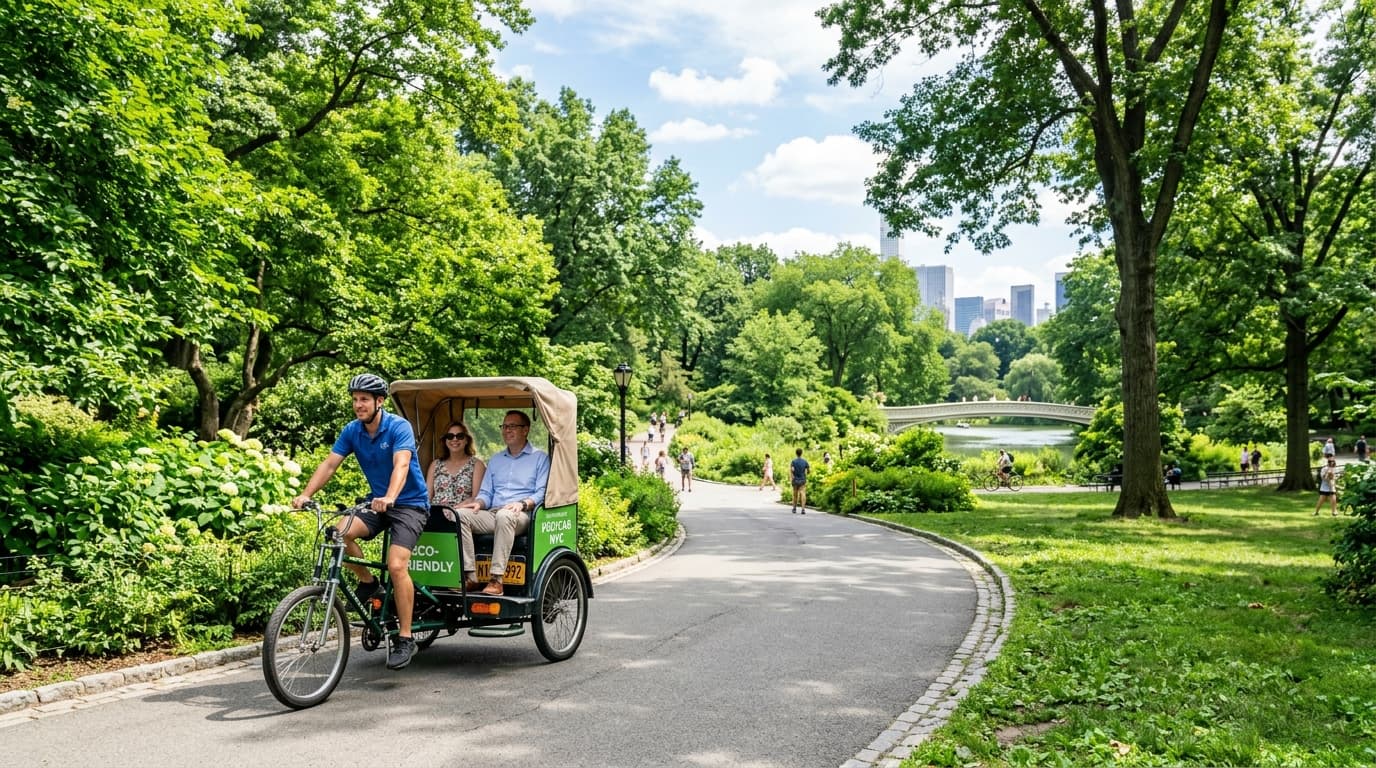
Pedicabs are the only zero-emission, human-powered way to take a guided tour of Central Park. No engine, no exhaust, no noise — just a licensed NYC driver pedaling you through 843 acres of green space while narrating the landmarks. A Classic Tour costs $45 per person for 1 hour and covers 15-20 stops including Bow Bridge, Bethesda Fountain, and Strawberry Fields. Compare that to a diesel tour bus circling the perimeter or a horse carriage limited to the southern edge of the park. For visitors who care about their environmental footprint — and a growing number do — pedicabs deliver the best park coverage with zero carbon output. No fuel burned. No particulate matter released into the air your kids are breathing. Just pedal power, fresh air, and a better tour.
Why Pedicabs Are the Greenest Tour Option in Central Park
A pedicab produces exactly zero emissions during operation. There is no engine — combustion or electric — involved. The driver pedals a three-wheeled cycle with a passenger bench. The energy source is human effort, which means no tailpipe exhaust, no battery manufacturing footprint during use, and no charging infrastructure required.
This matters inside Central Park specifically because the park functions as Manhattan's primary green lung. The Conservancy reports that Central Park's 18,000+ trees absorb approximately 48,000 pounds of carbon dioxide annually and filter airborne pollutants. Introducing diesel buses, idling vehicles, or even electric motors with brake dust into that environment works against the park's ecological purpose.
Pedicabs align with what the park is designed to do: provide clean air and green space in the middle of one of the densest cities on Earth.
Environmental Comparison: Pedicab vs Horse Carriage vs Bus Tour vs Electric Bike
Pedicabs have the lowest environmental impact of any guided tour option in Central Park. Here is how each option compares across the factors that actually matter.
| Factor | Pedicab | Horse Carriage | Bus Tour | Electric Bike Rental |
|---|---|---|---|---|
| Carbon emissions | Zero | Indirect (feed, transport, stable heating) | High (diesel) | Low (charging) |
| Noise pollution | Silent | Moderate (hooves, carriage) | High (engine, PA system) | Low |
| Air quality impact | None | Manure, methane | Exhaust fumes | Minimal |
| Road/path wear | Minimal | Significant (iron shoes) | Heavy | Minimal |
| Waste generated | None | Manure on streets | Fuel waste, tire wear | Battery disposal (eventual) |
| Guided narration | Yes | Usually no | Yes (PA system) | No |
| Price (1 hr, per person) | $45 | $100-200+ | $50-70 | $15-25 (self-guided) |
Horse carriages are often perceived as a "natural" option, but the full lifecycle includes feed production, manure management, horse transport to and from stables, and heated stable facilities. The NYC horse carriage industry generates measurable methane and requires daily waste removal from city streets.
Diesel tour buses are the worst offenders. A single idling tour bus produces roughly 20 pounds of CO2 per hour. Multiply that across the dozens of buses circling Central Park daily, and the cumulative impact is significant — especially along the park perimeter where pedestrians and cyclists breathe the exhaust directly.
Central Park's Own Sustainability Efforts
Central Park is one of the most significant ecological assets in New York City. The park spans 843 acres and contains over 18,000 trees, 250 acres of lawn, 150 acres of woodland, and 7 bodies of water. It is not just a recreational space — it is active environmental infrastructure.
The Central Park Conservancy, which manages the park, runs programs focused on water filtration, soil health, and biodiversity. The park's natural areas filter stormwater that would otherwise overwhelm the city's sewer system. Its tree canopy reduces the urban heat island effect in surrounding neighborhoods by measurable degrees.
Choosing a zero-emission tour option supports this ecosystem rather than degrading it. Every tour bus idling on the park loop road, every exhaust plume drifting into the treeline, works against the millions of dollars and volunteer hours invested in keeping this space healthy.
How Pedicabs Fit NYC's Sustainability Goals
New York City's Climate Mobilization Act (Local Law 97) sets carbon reduction targets for 2030 and 2050, and zero-emission transportation is a core component. The city's broader sustainability plan includes expanding bike infrastructure, reducing vehicle emissions in congested areas, and promoting human-powered transit.
Pedicabs are already aligned with these goals. They operate on the same bike lanes and park paths that the city has invested billions to build and protect. They require no charging stations, no fuel infrastructure, and no vehicle emissions testing.
NYC's Vision Zero initiative, aimed at eliminating traffic fatalities, also benefits from pedicab tourism. Pedicabs travel at 8-12 mph, weigh a fraction of a car or bus, and operate on paths separated from motor vehicle traffic. The safety profile is fundamentally different from any motorized tour option.
Why Eco-Conscious Travelers Choose Pedicabs
Sustainable tourism is not a niche preference anymore — it is a deciding factor for a large segment of travelers. A 2023 Booking.com survey found that 76% of global travelers said they wanted to travel more sustainably, and 43% said they would pay more for sustainable options.
Millennials and Gen Z travelers, who now represent the majority of tourism spending, are particularly likely to choose experiences based on environmental impact. For these visitors, the choice between a diesel bus tour and a human-powered pedicab is not close.
The practical appeal goes beyond ideology. A pedicab tour is:
- Quieter — you can actually hear the birds in the Ramble and your driver's narration without competing with an engine
- More intimate — 2-3 passengers with a personal guide, not 40 people on a bus with a PA system
- More flexible — your driver stops where you want, adjusts the route, and takes photos at your pace
- Better value — a Classic Tour at $45/person covers more ground inside the park than a $70 bus tour that mostly circles the perimeter
Supporting Local Green Jobs
Every Grinlo pedicab driver is a licensed NYC professional earning a living through zero-emission transportation. Drivers keep 60% of each fare plus 100% of tips. This is not gig-economy minimum — it is a real income stream for people who are physically fit, knowledgeable about the park, and committed to providing a great experience.
Pedicab driving is one of the few tourism jobs in NYC that requires no fossil fuel, no vehicle registration, and no commercial driver's license. Drivers maintain their own pedicabs, know Central Park's 58 miles of paths, and build repeat clientele through quality narration and service.
When you book a pedicab tour, you are directly supporting a local worker in a genuinely sustainable job — not a corporation running a fleet of diesel coaches.
The Noise Factor: Why Silence Matters in a Park
Pedicabs are effectively silent. The only sounds are the tires on the path, the driver's voice, and the park itself — birds, water, wind through the trees. This is not a minor detail.
Central Park was designed by Frederick Law Olmsted and Calvert Vaux as a retreat from the noise of the city. The sunken transverse roads were specifically engineered to hide crosstown traffic from park visitors. The park's acoustics are intentional.
Horse carriages produce rhythmic hoof strikes and carriage rattle. Tour buses produce engine noise and amplified PA narration audible from hundreds of feet away. Both disrupt the experience that Olmsted and Vaux spent years designing.
A pedicab respects that design. You move through the park quietly, hearing what you are supposed to hear.
Frequently Asked Questions
Are pedicabs really zero-emission? Yes. A pedicab is a human-powered three-wheeled cycle. There is no motor, no battery, and no fuel. The only energy input is the driver pedaling. During operation, a pedicab produces zero carbon emissions, zero exhaust, and zero noise pollution.
How do pedicab tour prices compare to other eco-friendly options? A Grinlo Express Ride is $35 per person for 30 minutes. The Classic Tour is $45 per person for 1 hour. The Grand Tour is $90 per person for 2 hours. Self-guided bike rentals are cheaper ($15-25/hour) but include no guide, no narration, and no stops for photos. Walking is free but covers far less ground in the same time.
Can I book a private eco-friendly tour for a special occasion? Yes. The Proposal Package is $100 per person for a private 1-hour tour designed for couples. The Sunset Special at $75 per person for 1.5 hours is popular for anniversaries and date nights. All tours are zero-emission regardless of the package.
Are pedicabs safe in Central Park? Pedicabs operate on dedicated park paths and the internal loop road, separated from motor vehicle traffic. Drivers travel at 8-12 mph. NYC requires pedicab operators to be licensed. Grinlo drivers carry insurance and are vetted before they join the platform. Read more in our comparison guide.
How does booking through Grinlo work? You select a tour, choose your date and time, and pay a fixed price online. No negotiation, no surprises. Our driver will contact you before your ride. You meet at Central Park South (59th St and 6th Ave). Learn more about Grinlo or compare tour options.
Ready to see Central Park the green way? Fixed prices, zero emissions, licensed NYC drivers.