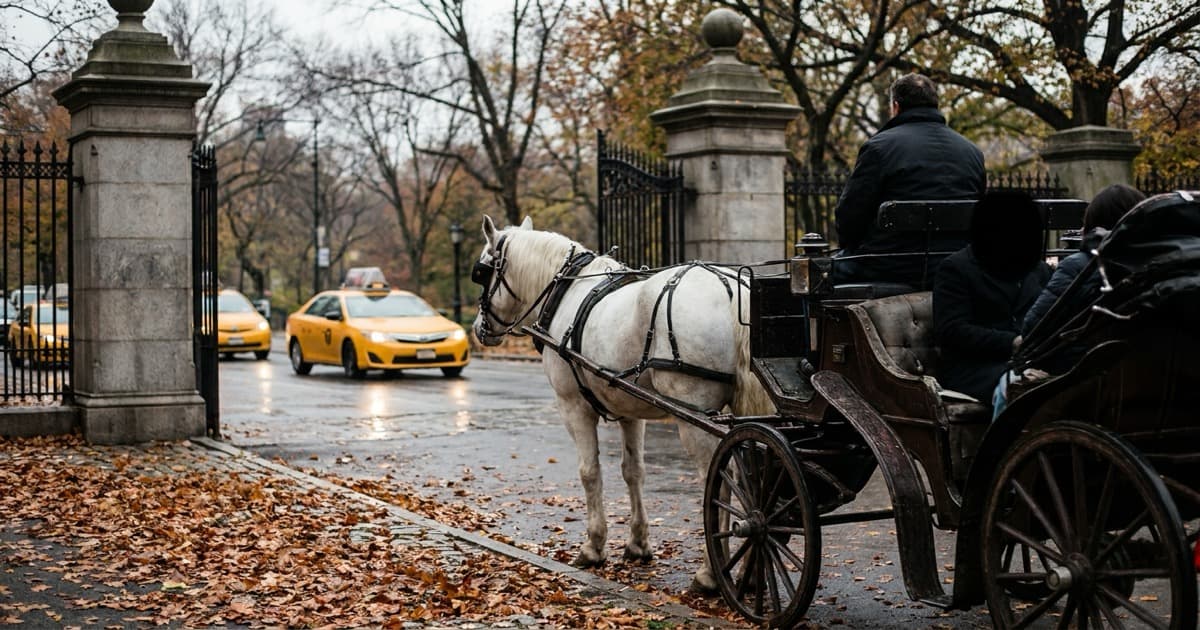
The debate over horse-drawn carriages in Central Park hit its rawest moment yet in June 2026, when an 18-year-old tourist was killed after the horse pulling his carriage bolted and the carriage overturned. Central Park carriage rides were suspended for several days while drivers went through safety training, then resumed the following week. The death put new momentum behind Ryder's Law, the City Council bill to phase out the industry that stalled in committee back in November 2025. Here is where things actually stand for tourists in 2026, and what your options are if you would rather skip the carriage.
What Is Ryder's Law?
Ryder's Law is a proposed piece of New York City legislation that would permanently end horse-drawn carriage operations in Central Park and surrounding streets. The bill was introduced in the NYC City Council in 2025.
The bill is named after Ryder, a carriage horse who collapsed on a Manhattan street while pulling passengers in summer heat. The incident was widely filmed and shared on social media, reigniting a decades-long debate about animal welfare in New York City's tourism industry.
Current status (July 2026): The bill was voted down 1-4 in committee in November 2025 and did not advance to a full council vote. Since then the pressure has only grown. A May 2026 carriage collision hospitalized a driver, and on June 17, 2026 an 18-year-old tourist was killed when a carriage horse bolted in the park. City leaders and animal-welfare groups renewed their push for a ban after his death. Even so, no ban has passed. Operators paused briefly for safety training in June and are running again, so horse carriages continue to operate in Central Park as of July 2026.
The June 2026 Central Park carriage-horse death
On June 17, 2026, an 18-year-old tourist was killed in Central Park when the horse pulling his carriage bolted and the carriage overturned. It was the kind of incident carriage-ban advocates had warned about for years, and it made national news.
Within days, the carriage drivers' union, TWU Local 100, voluntarily suspended all Central Park operations and put drivers through refresher safety training. Passenger rides resumed the following week. City leaders and groups like NYCLASS used the moment to renew calls for Ryder's Law and a full phaseout of the industry. Some of the bill's backers have also moved to rename it Romanch's Law, after the teenager who was killed.
If the news has you rethinking a carriage ride, the best horse carriage alternative in Central Park is a pedicab tour: the same seated, guided ride, with a licensed driver and no horse involved. It is the humane option most visitors reach for once they have read the headlines.
The May 2026 Central Park Carriage Collision
On the afternoon of Monday, May 18, 2026, two horse-drawn carriages collided near the West 59th Street and West Drive entrance to Central Park. One carriage overturned, and its driver — a 44-year-old coachman — was taken to NewYork-Presbyterian Weill Cornell Medical Center in stable condition. No passengers were in the carriage, and the horses were not physically injured.
Accounts of the cause differ. City officials said a horse was startled by an abrupt movement; the carriage drivers' union, TWU Local 100, disputed that and said the two carriages crossed wheels as one pulled away from the line. NYCLASS noted that a heat advisory and an air quality alert were in effect in the city that day.
The incident drew an immediate response. The Central Park Conservancy called it "a stark reminder of the dangers that horse-drawn carriages pose" and renewed its call for a citywide ban. NYCLASS urged the City Council to reintroduce Ryder's Law, citing a poll showing 78% of New York voters support phasing out carriage horses.
For tourists, the practical takeaway is unchanged: carriages are still operating, and the choice of how to tour the park is yours. If you would rather avoid the safety and animal-welfare questions entirely, a pedicab tour offers the same seated, guided ride with no horses involved.
Why Was the Bill Proposed?
The movement to ban horse carriages from Central Park is not new. Animal welfare organizations have campaigned against the practice since the 1990s. Several factors drove the latest legislative push:
Animal Welfare Concerns
Carriage horses in Manhattan work in conditions that many veterinary experts consider harmful. Horses pull heavy carriages on asphalt in temperatures that regularly exceed 90 degrees Fahrenheit in summer. They navigate alongside buses, taxis, and delivery trucks on some of the busiest streets in the world. Between shifts, horses are stabled in multi-story buildings in Midtown Manhattan — far from the pastures and open space that horses need for their physical and psychological health.
Multiple incidents of horses collapsing, bolting into traffic, or showing signs of distress have been documented over the years. Ryder's collapse was not an isolated event; it was just the most visible one, until the fatal June 2026 accident reset the conversation entirely.
Traffic Safety
Horse carriages share the road with motor vehicles, cyclists, and pedestrians. Accidents involving carriages have resulted in injuries to both horses and people. The NYPD has responded to numerous incidents of horses being spooked by sirens, horns, or sudden movements — leading to dangerous situations in dense pedestrian areas around Central Park South.
Changing Public Opinion
Surveys conducted in 2024 and 2025 showed that a growing number of New York City residents support ending the carriage industry. Tourism industry polls found that while some visitors considered carriage rides a "must-do" experience, most were open to alternatives once they understood the animal welfare implications.
Available Alternatives
The existence of pedicab tours, walking tours, bike rentals, and electric vehicle tours gave supporters confidence that tourists would still have guided tour options. The carriage ride experience — seeing Central Park from a seated, guided vehicle — is closely replicated by pedicab tours, which have operated in Central Park since the 1990s.
What Does This Mean for Tourists in 2026?
Horse carriages are still operating. As of May 2026, you can still take a horse carriage ride in Central Park. Carriages stage along Central Park South (59th Street) and operate daily, weather permitting.
However, many visitors are already choosing alternatives for ethical, practical, or financial reasons. Here are your options:
-
Pedicab tours — The closest alternative to the carriage experience. You sit in a covered, three-wheeled cycle while a licensed driver pedals you through the park and narrates landmarks. Grinlo offers fixed-price pedicab tours starting at $35 per person, covering 8-25 landmarks depending on the tour length.
-
Walking tours — Free (self-guided) or $30-60 for guided group tours. Good exercise but slow — you will see fewer landmarks in the same time.
-
Bike rentals — $15-25 per hour from Citi Bike or private shops. Fun but no narration, and you have to navigate the park yourself.
-
Electric golf cart tours — A newer option, limited availability, $50-100 per person.
Pedicab Tours: The Best Alternative to Horse Carriages
Pedicab tours are the most direct alternative to the horse carriage experience. Here is why:
Same Seated Experience
Like a carriage, you sit back and enjoy the ride while someone else does the work. You do not have to pedal, walk, or navigate. The driver handles everything.
Better Park Coverage
This is where pedicabs improve on the carriage experience. Horse carriages are restricted to the park's perimeter roads — the main loop drives that also carry motor vehicles. Carriages cannot enter the interior paths where many of Central Park's most famous landmarks are located.
Pedicabs can access the interior paths. A Classic Tour covers Bow Bridge, Bethesda Fountain, Strawberry Fields, the Literary Walk, Belvedere Castle, and 10-15 other landmarks — most of which carriages never reach.
Lower Cost
Horse carriage rides typically cost $75-$400 depending on duration and negotiation skills. Pricing is often opaque, with tourists reporting being overcharged after the ride.
Grinlo pedicab tours use fixed pricing that you see and agree to before booking:
- Express Ride (30 min, 8-10 landmarks): $35/person
- Classic Tour (1 hour, 15-20 landmarks): $45/person
- Grand Tour (2 hours, 25+ landmarks): $90/person
- Sunset Special (1.5 hours at golden hour): $75/person
All prices are per person, all-inclusive, with no negotiation or tipping pressure.
Zero Animal Welfare Concerns
Pedicabs are 100% human-powered. No animals are involved. The driver is a licensed NYC pedicab operator who chose this job. They are paid, insured, and free to take breaks whenever they want. The ethical concerns that motivated Ryder's Law simply do not apply.
Licensed and Regulated
All pedicab operators in NYC must hold a license from the Department of Consumer and Worker Protection. Grinlo drivers undergo background checks and carry commercial liability insurance. Every pedicab displays a visible license plate — if it does not, do not get on.
The History of Horse Carriages in Central Park
Horse-drawn carriages have operated in Central Park since the park opened in 1858. For over 160 years, they have been a fixture of the New York City tourism landscape. At their peak, over 200 horses worked the Central Park routes.
As of 2025, the industry had shrunk to approximately 68 licensed horses and 130 drivers. The carriage operators have fought proposed bans through political lobbying, legal challenges, and media campaigns. They argue that the horses are well cared for and that the industry provides good jobs.
Supporters of a ban counter that the working conditions are inherently unsuitable for horses regardless of individual operator care — the heat, traffic, pavement, and confinement cannot be remedied within the existing framework.
The debate has lasted over 30 years. Ryder's Law is the latest chapter, not the final one.
What Would Happen to the Horses If a Ban Passes?
Ryder's Law included provisions for transitioning carriage horses to retirement:
- Sanctuary placement — Partnering with equine sanctuaries in New York, New Jersey, and Pennsylvania to place retired horses in pasture environments.
- Adoption programs — Qualified private adopters could apply to take in retired carriage horses.
- Veterinary care — Transition funding would cover health assessments and any needed medical treatment.
Animal welfare organizations, including the ASPCA and NYCLASS, have committed to supporting the rehoming process if and when legislation passes.
How to Book a Central Park Tour in 2026
Whether you want to skip the carriage for ethical reasons or simply prefer a better value tour, booking a pedicab ride online is the easiest way to see Central Park with a guide. Here is how it works with Grinlo:
- Choose your tour — Pick from five tour options based on how much time you have and what you want to see.
- Book online — Select your date and time. You will receive instant confirmation.
- Meet your driver — All tours meet at the 59th Street and 6th Avenue entrance to Central Park. Your driver will be waiting with a Grinlo pedicab.
- Enjoy the ride — Sit back, listen to the narration, take photos, and ask questions. The driver adapts the route and pace to your interests.
No negotiation. No surprises. No animal welfare concerns. Just a great tour of one of the world's most famous parks.
Frequently Asked Questions
Is Ryder's Law passed? Are horse carriages banned?
No. Ryder's Law was proposed but did not pass committee in November 2025 (voted down 1-4). Horse carriages continue to operate in Central Park as of May 2026. The movement for a ban continues with support from Mayor Mamdani.
Was there a recent Central Park carriage accident?
Yes. On May 18, 2026, two horse-drawn carriages collided near the West 59th Street entrance to Central Park. One carriage overturned and its driver was hospitalized in stable condition; no passengers were aboard and the horses were not injured. The Central Park Conservancy and animal-welfare group NYCLASS used the incident to renew their calls for a ban under Ryder's Law. As of May 2026, no ban has passed and carriages continue to operate.
Can I still take a horse carriage ride in Central Park?
Yes. Horse carriages operate daily from Central Park South (59th Street). Prices range from $75-$400 depending on duration and negotiation.
Are pedicab rides safe?
Yes. Pedicab operators are licensed by NYC, carry insurance, and operate at low speeds (under 12 mph) on dedicated bike paths. Grinlo drivers undergo additional background checks and safety training.
How much does a pedicab tour cost compared to a carriage ride?
Pedicab tours start at $35 per person for a 30-minute ride. Carriage rides typically cost $75-$400 total. Pedicabs are consistently less expensive and cover more of the park.
Where do pedicab tours start?
Grinlo tours depart from the 59th Street and 6th Avenue entrance — near where horse carriages stage. It is two blocks from the Plaza Hotel and directly accessible from the N/R/W subway at 5th Ave-59th St.
Do I need to book in advance?
We recommend booking online at least a day ahead, especially for weekends and the sunset tour. Walk-ups are available but subject to driver availability.
Central Park has options for every visitor. If you want the guided, seated tour experience without the animal welfare questions, book a pedicab tour today and see the park the way it was meant to be seen — at a relaxed pace, with a knowledgeable guide, and powered entirely by human effort.